Mindory
A full UX/UI redesign of the most supportive task scheduler for people with ADHD and Autism — turning overwhelming to-do lists into realistic schedules, with personalised AI-powered guidance to keep you on track.
(Client)
AutiHD
(Year)
2026
(Services)
UX Design, UI Design
Problem Statement
Task management tools weren't built for the neurodivergent brain People with ADHD and Autism face a specific and underserved challenge: standard productivity apps assume a neurotypical relationship with time, priority, and self-regulation. For this audience, a simple to-do list doesn't just fail — it actively compounds anxiety. Mindory had an existing product, but the original designs were clunky, unintuitive, and visually overwhelming — ironically the opposite of what the user base needed. The app had the right intent but the wrong execution. The brief was to rebuild the complete user experience from the ground up: new flows, new design identity, new interaction model.


Solution
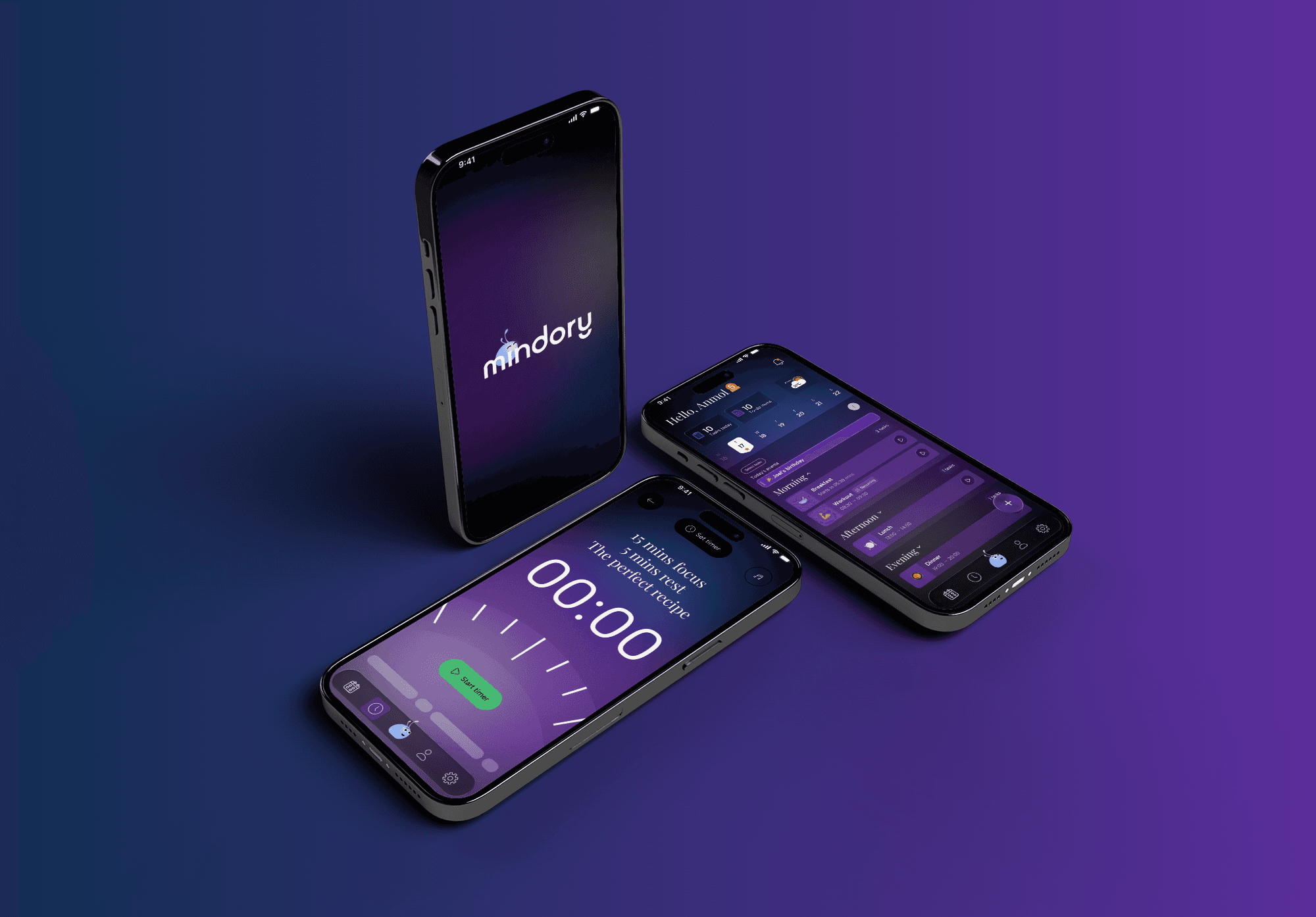
A complete UX redesign built around calm, clarity, and personalised AI-powered support As the sole designer, I rebuilt Mindory's user experience from scratch — new user journey flows, a coherent design system, and a new interaction model centred on Mindy, an AI companion that adapts to each user's cognitive profile. The result is an app that feels like a supportive tool rather than another source of pressure. The design introduces natural language task creation, a dual-mode dashboard (continuous timeline and grouped day view), a focus timer built on the Pomodoro method, and a stress dial that feeds directly into scheduling — making Mindory the first productivity tool to treat mental state as a scheduling input.
Mindory
A full UX/UI redesign of the most supportive task scheduler for people with ADHD and Autism — turning overwhelming to-do lists into realistic schedules, with personalised AI-powered guidance to keep you on track.
(Client)
AutiHD
(Year)
2026
(Services)
UX Design, UI Design
Problem Statement
Task management tools weren't built for the neurodivergent brain People with ADHD and Autism face a specific and underserved challenge: standard productivity apps assume a neurotypical relationship with time, priority, and self-regulation. For this audience, a simple to-do list doesn't just fail — it actively compounds anxiety. Mindory had an existing product, but the original designs were clunky, unintuitive, and visually overwhelming — ironically the opposite of what the user base needed. The app had the right intent but the wrong execution. The brief was to rebuild the complete user experience from the ground up: new flows, new design identity, new interaction model.
Solution
A complete UX redesign built around calm, clarity, and personalised AI-powered support As the sole designer, I rebuilt Mindory's user experience from scratch — new user journey flows, a coherent design system, and a new interaction model centred on Mindy, an AI companion that adapts to each user's cognitive profile. The result is an app that feels like a supportive tool rather than another source of pressure. The design introduces natural language task creation, a dual-mode dashboard (continuous timeline and grouped day view), a focus timer built on the Pomodoro method, and a stress dial that feeds directly into scheduling — making Mindory the first productivity tool to treat mental state as a scheduling input.
Mindory
A full UX/UI redesign of the most supportive task scheduler for people with ADHD and Autism — turning overwhelming to-do lists into realistic schedules, with personalised AI-powered guidance to keep you on track.
(Client)
AutiHD
(Year)
2026
(Services)
UX Design, UI Design
Problem Statement
Task management tools weren't built for the neurodivergent brain People with ADHD and Autism face a specific and underserved challenge: standard productivity apps assume a neurotypical relationship with time, priority, and self-regulation. For this audience, a simple to-do list doesn't just fail — it actively compounds anxiety. Mindory had an existing product, but the original designs were clunky, unintuitive, and visually overwhelming — ironically the opposite of what the user base needed. The app had the right intent but the wrong execution. The brief was to rebuild the complete user experience from the ground up: new flows, new design identity, new interaction model.
Solution
A complete UX redesign built around calm, clarity, and personalised AI-powered support As the sole designer, I rebuilt Mindory's user experience from scratch — new user journey flows, a coherent design system, and a new interaction model centred on Mindy, an AI companion that adapts to each user's cognitive profile. The result is an app that feels like a supportive tool rather than another source of pressure. The design introduces natural language task creation, a dual-mode dashboard (continuous timeline and grouped day view), a focus timer built on the Pomodoro method, and a stress dial that feeds directly into scheduling — making Mindory the first productivity tool to treat mental state as a scheduling input.